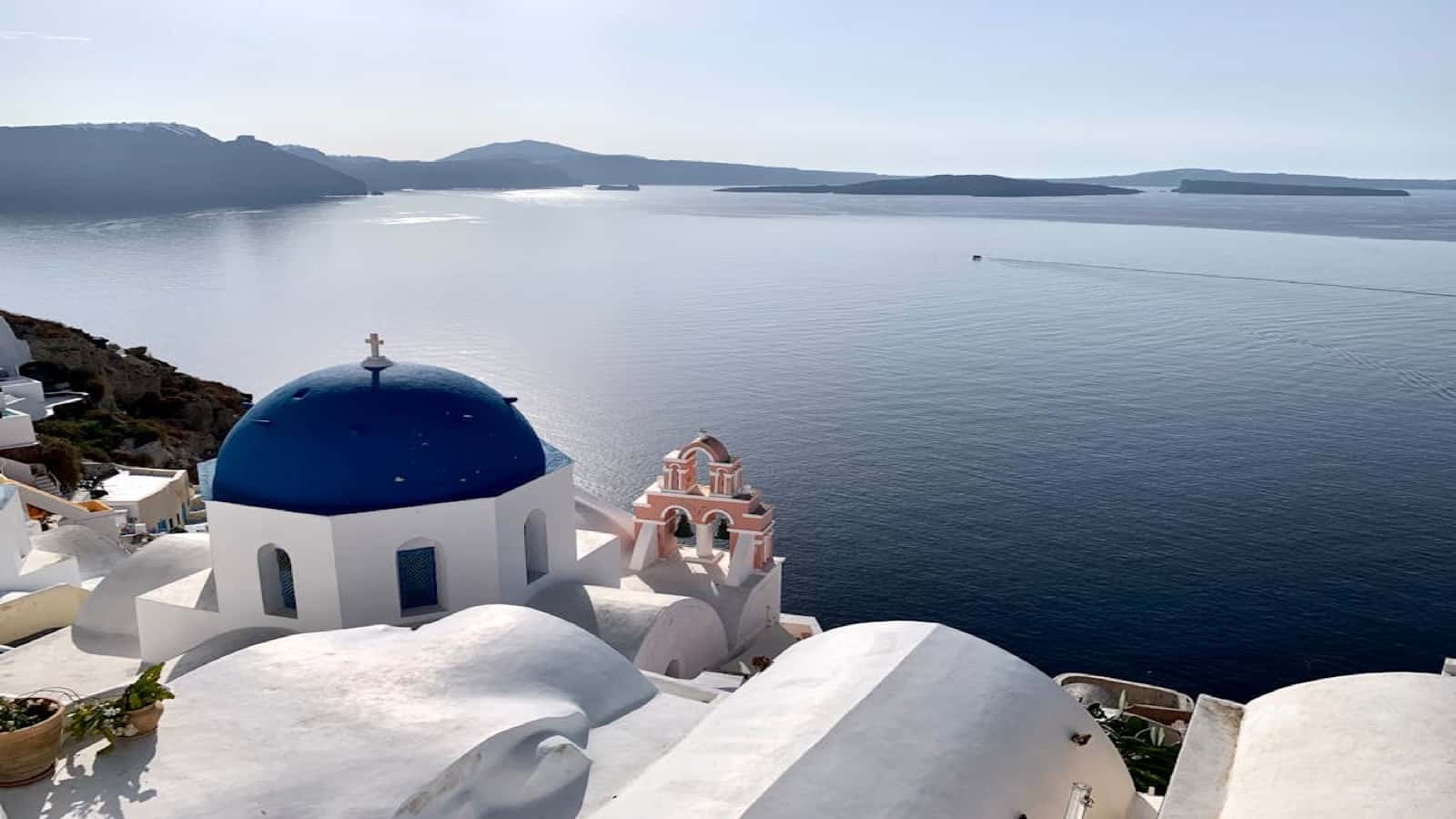
Greece is one of the most seasonally lopsided destinations in Europe. The same Santorini caldera that feels romantic and uncrowded in early May becomes a two-hour-line-for-the-sunset bottleneck by mid-July, and the same Athens neighborhoods that are walkable in spring turn into 38-degree concrete furnaces by August. Choosing the right month is not a minor optimization — it can be the difference between the trip people remember for years and the trip they describe afterward as "beautiful but exhausting." The data points to one window that consistently outperforms the rest: May.
How we evaluated
This verdict draws on three categories of public data. First, ELSTAT (the Hellenic Statistical Authority) publishes month-by-month visitor arrival statistics for Greece's main tourism regions, which show clear seasonal density patterns across Athens, the Cyclades (including Santorini and Mykonos), the Ionian islands, and Crete. Second, historical pricing data from Google Flights and major OTAs for both flights into Athens (ATH) and Thessaloniki (SKG), as well as island accommodation inventory, makes it possible to compare cost across months over multiple years rather than a single anomalous season. Third, recurring community consensus threads on r/greece, r/travel, and r/solotravel — particularly the monthly "when to visit" megathreads — provide on-the-ground reports from people who have actually been in Oia at sunset in July versus May. No claim of personal travel is made anywhere in this article.
The verdict
May is the single best month to visit Greece for first-time visitors and anyone whose itinerary includes Santorini, Mykonos, or other Cycladic islands. ELSTAT data consistently shows May running 35-45% below August in visitor density, while flight and hotel prices run 25-35% below peak. Weather is warm and predominantly sunny, the Aegean is swimmable for those who want it, and the major sights — the Acropolis, Delphi, the Santorini caldera, the Mykonos old town — operate at full capacity without the queues, reservation gauntlets, and crowd-management overhead that define July and August. The Worth-It Score is 9.0.
The evidence
ELSTAT visitor data shows May runs 35-45% below peak
Greece's official tourism statistics, published by ELSTAT, consistently show July and August as the two highest-traffic months, with the island destinations experiencing the sharpest peaks. May is classified as pre-peak shoulder season in ELSTAT's analysis. Visitor arrival numbers in May run roughly 35-45% below August across the country and significantly below that on the most concentrated islands. The practical translation of those percentages is direct and immediate: shorter lines at the Acropolis, accessible viewpoints at Oia, restaurants in Plaka and Mykonos Town that don't require a week's advance reservation, and ferry terminals that aren't operating at saturation. The same archaeological sites, the same sunsets, the same cuisine — at roughly two-thirds the human density.
Pricing data shows 25-35% savings on flights and accommodation
Historical pricing for US-to-Athens (ATH) and US-to-Thessaloniki (SKG) routes shows May fares running 25-35% below July and August across multiple years of OTA and Google Flights data. The compounding effect on island accommodation is even more significant. Santorini cave hotel pricing in August regularly exceeds $500 per night for mid-range properties, while comparable dates in May routinely run $200-350. Mykonos shows a similar but less extreme pattern. For a typical 10-day Greece itinerary covering Athens, Santorini, and one additional island, the total trip cost difference between May and August can easily exceed $1,000 per person, and that is before accounting for restaurant and activity prices, which also run materially higher in peak season.
The weather case for May is stronger than most travelers expect
Greece's Mediterranean climate means May delivers warm, predominantly sunny days. Athens averages 22-25°C (72-77°F) in May. Santorini averages 20-23°C (68-73°F). The Aegean sea temperature in May runs 19-21°C (66-70°F) — cool by Mediterranean summer standards but swimmable, and fully comfortable for boat trips, snorkeling, and beach time for those who want it. The oppressive heat that characterizes July and August in Athens, where temperatures regularly hit 35-38°C (95-100°F) and the marble of the Acropolis becomes physically uncomfortable to walk on by mid-morning, is simply absent in May. Daylight runs roughly 14 hours, restaurants put their tables outside, and ferry days don't start with the heat exhaustion warnings that summer routes generate.
The Santorini sunset calculus
The Oia sunset is one of the most photographed scenes in travel, and it is also one of the most crowd-sensitive. Community consensus on r/greece, r/travel, and r/solotravel — across years of recurring threads — documents tourists in July and August arriving 1.5 to 2-plus hours before sunset to claim any usable position on the castle ruins or main viewpoint walls. By July peak, the experience is described less in terms of romance and more in terms of crowd management. The same threads describe May as a different category entirely: arriving 30 minutes before sunset is sufficient to find a good spot with space to breathe. Same sunset. Dramatically different experience. For couples who specifically chose Santorini for that view, the month chosen determines whether the photo is the experience or whether it was earned through 90 minutes of wedged-in waiting.
How May compares to September, the other shoulder window
September and early October offer similar advantages — crowds dropping after August, prices falling, weather still excellent. The differences matter. Sea temperatures peak in September at 25-26°C (77-79°F), which gives September a slight edge for travelers focused on warm-water swimming and beach activities. May, on the other hand, has more daylight hours, everything operating at full peak-season capacity, and an "opening up" feeling rather than the "winding down" mood that begins to creep into October. Community opinion is split between the two months, and reasonable travelers can pick either. May edges it for first-time visitors specifically, because every restaurant, ferry route, and seasonal site is fresh and open, and because the energy of the country in May tilts toward beginning rather than ending.
Who it's best for
For: First-time Greece visitors
The Acropolis, Delphi, Santorini, and Mykonos are all accessible without the summer crush. May gives a first trip the headline images — the caldera, the Parthenon, the Oia sunset — without the queues and crowd-management overhead that define July and August. For a trip people will look back on as their introduction to the country, the difference between May and peak is the difference between savoring and surviving.
For: Couples targeting Santorini and Mykonos
The romantic experience these islands are sold on — quiet caldera dinners, accessible sunset views, walks through Oia and Mykonos Town that aren't shoulder-to-shoulder — is genuinely available in May at roughly 60-70% of peak pricing. The same caves, the same whitewashed lanes, the same view, with measurably more space and notably lower hotel bills.
For: Island hoppers avoiding peak crowds
Ferry connections between major Cycladic islands are operating in May, accommodation is broadly available without the multi-month advance booking peak summer requires, and the smaller islands in particular are far more relaxed than they will be six weeks later. May is the window for travelers who want to cover three or four islands without the logistical contortions of high season.
What it doesn't beat
May is not the universal best answer. It does not beat July through September for the warmest Mediterranean swimming water — sea temperatures peak in late August and September at 25-26°C, and travelers whose primary goal is beach and water time will get a measurably warmer experience then. It does not beat peak summer for the full "Greek summer party" atmosphere on Mykonos, where the headline beach clubs and DJ-driven nightlife scene operates at full intensity from late June through August. And it does not beat October for absolute lowest prices, though October comes with reduced ferry schedules to smaller islands and a small number of seasonal restaurants and hotels closing for the season. May is the best blend month — strong on every dimension that matters and dominant on most — but it is not the strongest on every single one.
Verdict
The Verdict
May Travel Window for Greece
Best For
First-time Greece visitors and couples wanting Santorini/Mykonos without peak crowds
Beats
June through August on price, crowd density, and Santorini sunset access
Doesn't Beat
Peak summer for warmest swimming water or beach-only island trips
Based on 3 data sources · Last verified May 1, 2026
Sources
- ELSTAT (Hellenic Statistical Authority) monthly tourism arrival statistics by region — official Greek government tourism data showing May at 35-45% below August visitor density across the Cyclades and mainland
- Google Flights and OTA historical pricing data for ATH and SKG routes from US gateways across multiple years, plus Santorini and Mykonos accommodation pricing across major OTAs
- r/greece, r/travel, and r/solotravel recurring monthly recommendation threads — community consensus on Oia sunset crowd dynamics, ferry experience, and May vs. September trade-offs
- Hellenic National Meteorological Service climate normals for Athens, Santorini, and Mykonos covering temperature, sea temperature, and precipitation by month
- Greek Travel Pages (gtp.gr) ferry schedule data confirming May operating routes across major Cycladic and Ionian connections